
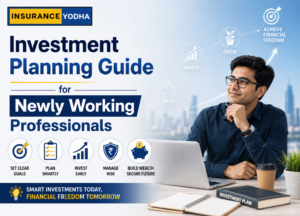
Starting your first job is an exciting milestone. For many newly working professionals, receiving a regular salary for the first time brings financial independence and new opportunities. However, it also comes with an important responsibility: learning how to manage income effectively.
The early years of your career can be an excellent time to develop strong financial habits. Instead of spending your entire salary, you can create a balanced strategy that includes budgeting, emergency savings, insurance protection, investments and long-term wealth creation.
Investment planning for newly working professionals does not necessarily mean investing a large amount of money from the beginning. It means starting with realistic amounts, investing consistently and gradually increasing your investments as your income grows.
A well-structured financial plan can help you work toward goals such as buying a home, building wealth, supporting your family, travelling, starting a business or preparing for retirement.
📞 Get FREE Financial Planning Consultation
Call / WhatsApp: +91-9540059589
Get guidance on insurance and financial planning based on your individual requirements.
1. Understand Your Monthly Income and Expenses
The first step in investment planning is understanding where your money goes.
When you receive your salary, divide your income into different categories such as:
- Essential household expenses
- Rent and utilities
- Transportation
- Food and lifestyle expenses
- Insurance premiums
- Emergency savings
- Investments
- Discretionary spending
You do not need to follow a rigid budgeting formula. The important thing is to ensure that your spending does not consistently consume your entire income.
Tracking expenses for the first few months can help you understand your actual spending habits.
2. Create an Emergency Fund
Before focusing heavily on long-term investments, consider creating an emergency fund.
An emergency fund can provide financial support for unexpected situations such as:
- Temporary loss of income
- Medical expenses
- Urgent family requirements
- Unexpected travel
- Major repairs
- Other unforeseen expenses
The appropriate amount depends on your income, expenses, job stability and family responsibilities.
Keep emergency savings in relatively accessible and suitable low-risk options rather than putting all of it into long-term or market-linked investments.
3. Get Adequate Health Insurance
Many young employees depend entirely on employer-provided health insurance. While employer coverage can be useful, it may not always provide sufficient protection for every situation.
When evaluating health insurance, consider:
- Sum insured
- Coverage features
- Waiting periods
- Exclusions
- Network hospitals
- Premium
- Policy conditions
Having appropriate health insurance can help protect your savings from unexpected eligible medical expenses.
4. Consider Life Insurance When You Have Dependents
Not every young professional has the same life insurance requirement.
If nobody financially depends on your income, your immediate life insurance need may differ from someone who supports parents, a spouse or children.
However, once you have financial dependents or significant liabilities, life insurance can become an important part of financial protection planning.
Term insurance is generally designed to provide life cover for a specified period, subject to policy terms and conditions.
The appropriate coverage depends on factors such as income, liabilities, dependents, existing assets and future financial goals.
5. Start Investing Early
One of the biggest advantages available to newly working professionals is time.
Long-term investing can benefit from the power of compounding, where returns that remain invested can potentially generate further returns over time.
Starting with a manageable amount and increasing it gradually may be more sustainable than waiting several years to invest a large amount.
For example, instead of waiting until your salary doubles, you can begin investing a small amount every month and increase the contribution when your income rises.
6. Understand SIPs
A Systematic Investment Plan, commonly called a SIP, allows an investor to invest a predetermined amount regularly into a suitable mutual fund scheme.
SIPs can help develop investment discipline because the investment is made at regular intervals.
Potential advantages include:
- Regular investing
- Investment discipline
- Long-term compounding potential
- Convenient automated contributions
- Reduced dependence on trying to time the market
However, mutual fund investments are subject to market risks. SIPs do not guarantee profits or protect investors from losses.
Choose investments according to your financial goals, investment horizon and risk tolerance.
7. Choose Investments According to Your Goals
Young professionals often make the mistake of selecting investments solely based on recent returns.
Instead, begin with the goal.
For example:
| Financial Goal | Possible Time Horizon | Planning Approach |
|---|---|---|
| Emergency Fund | Short term | Accessible, suitable low-risk savings |
| Vacation | Short term | Goal-based savings |
| Higher Education | Medium/long term | Diversified approach based on horizon |
| Home Purchase | Medium/long term | Goal-specific planning |
| Retirement | Long term | Long-term diversified strategy |
The exact investment products should be selected after evaluating your circumstances and risk profile.
8. Start Retirement Planning Early
Retirement may seem far away when you are in your twenties or early thirties, but starting early can provide a major advantage.
You potentially have several decades for your investments to grow.
Even if your initial investment is small, developing the habit early can make retirement planning easier.
As your salary increases, gradually increase your retirement contributions.
9. Avoid Lifestyle Inflation
Getting your first significant salary can make it tempting to upgrade your lifestyle immediately.
You may want:
- A new smartphone
- A better car
- Expensive gadgets
- Frequent restaurant visits
- Luxury travel
- Premium subscriptions
Enjoying your income is not necessarily a problem. The challenge occurs when every salary increase results in higher expenses and no increase in savings.
A better approach is to increase your investments and savings alongside your lifestyle.
10. Manage Credit Cards Responsibly
Credit cards can be convenient, but unpaid balances can become expensive.
Avoid using credit cards to finance expenses that you cannot comfortably repay.
Pay attention to:
- Outstanding balances
- Interest charges
- Payment deadlines
- Annual fees
- Unnecessary purchases
High-cost debt can reduce the money available for long-term investing.
11. Set Specific Financial Goals
“Save money” is a vague objective.
Instead, create measurable goals.
For example:
Goal 1: Build an emergency fund within 12 months.
Goal 2: Invest a fixed amount every month.
Goal 3: Increase investment contributions annually.
Goal 4: Save for a home down payment.
Goal 5: Build a retirement corpus.
Specific goals make it easier to track your progress and adjust your strategy.
12. Increase Investments as Your Salary Grows
Your first salary will probably not be your highest salary.
As your career progresses, you may receive increments, bonuses or promotions.
Instead of allowing all additional income to become additional spending, consider increasing your investments.
For example, if your monthly investment is ₹5,000 today, you could review it whenever your income increases.
This is commonly referred to as a step-up investment strategy.
Increasing investments gradually can potentially accelerate long-term wealth creation.
13. Diversify Your Investments
Avoid putting all your money into a single investment or asset class without considering the associated risks.
Diversification can help spread exposure across different investments.
The appropriate allocation depends on:
- Age
- Income
- Risk tolerance
- Financial goals
- Investment horizon
- Existing investments
Do not diversify simply for the sake of owning many products. Each investment should have a clear purpose in your overall financial plan.
14. Review Your Financial Plan Every Year
Your financial situation can change significantly during the early stages of your career.
You may:
- Change jobs
- Get a salary increase
- Get married
- Start supporting parents
- Purchase a home
- Take a loan
- Start a business
- Have children
Whenever your circumstances change, review your savings, investments, insurance and financial goals.
An annual financial review can help keep your strategy aligned with your changing responsibilities.
Common Investment Mistakes Young Professionals Should Avoid
Investing Without an Emergency Fund
Long-term investments may not be easily accessible or suitable for unexpected expenses.
Chasing Quick Returns
Promises of very high returns often come with higher risks. Understand the product before investing.
Ignoring Insurance
A financial plan should include appropriate risk protection along with investments.
Starting Too Late
Waiting for a higher salary can mean losing valuable time for long-term compounding.
Taking Excessive Debt
Uncontrolled debt can reduce your ability to save and invest.
Following Friends’ Investments
An investment that works for someone else may not be suitable for your financial situation.
Not Reviewing Investments
Your financial goals and risk profile can change over time.
A Simple Financial Planning Framework for Your First Job
Newly working professionals can start with this simple framework:
Earn → Budget → Emergency Fund → Insurance → Invest → Increase Investments → Review
The goal is not to become financially perfect immediately. The goal is to develop sustainable habits that can continue throughout your career.
Frequently Asked Questions
1. When should a newly working professional start investing?
You can start once you have a stable income and have considered your immediate financial needs. Starting early can provide more time for long-term compounding.
2. How much should a beginner invest every month?
There is no fixed amount suitable for everyone. Start with an amount that fits comfortably within your budget while allowing you to manage essential expenses and build emergency savings.
3. Is SIP good for beginners?
SIPs can help investors develop regular investing habits. However, the suitability of a mutual fund depends on the investor’s goals, risk profile and investment horizon, and returns are not guaranteed.
4. Do young professionals need life insurance?
The need depends on financial dependents, liabilities and personal circumstances. Once others depend on your income, adequate life protection becomes increasingly important.
5. Should I invest before buying a car or expensive gadgets?
Major purchases should be evaluated against your income, savings, debt and financial goals. Avoiding unnecessary debt can help preserve your ability to invest for the future.
Why Financial Planning Matters Early in Your Career
Your first job is not only the beginning of your professional career—it can also be the beginning of your financial journey.
Developing good money habits early can help you:
- Control unnecessary expenses
- Build emergency savings
- Protect yourself and your family
- Invest consistently
- Prepare for major financial goals
- Work toward long-term wealth creation
The most important step is to start with a realistic plan and improve it as your income and responsibilities grow.
Get the Best Insurance Plans in India
Facing Financial Planning Problems? Don’t wait.
📞 Call / WhatsApp: +91-9540059589
🌐 Visit: insuranceyodha.com
👇 Fill the enquiry form below for:
✔️ Free consultation
✔️ Insurance planning guidance
✔️ Financial protection guidance
✔️ Assistance in understanding suitable insurance options
Contact Details – Insurance Yodha
Call/WhatsApp: +91-9540059589
Email: email@insuranceyodha.com
Website: insuranceyodha.com
Our Services: insuranceyodha.com/service.html
Important: Investment products, including market-linked products, are subject to market risks. Returns are not guaranteed unless specifically stated under the applicable product terms. Insurance products are subject to policy terms, conditions, exclusions and eligibility requirements. Readers should carefully review relevant product documents and seek appropriate professional advice based on their individual circumstances.